
Greek And Roman Deities On Coins-28
2026-02-13 Fri
In #ancient #Greek religion, Hygieia is honored as the goddess of #Health, cleanliness, and hygiene. Her name is the origin of the term "hygiene." Initially, she was seen as the protector of physical well-being. Later, her role expanded to include mental health. Her #Roman counterparts are the goddesses Salus and #ValeTudo.Hygieia belonged to the Asklepiades, the children of Asklepios, the god of #Medicine, and Epione, the goddess of #Healing. You can find detailed information about Asklepios here: Greek And Roman Deities On Coins-22 and further insights regarding Epione here: Greek And Roman Deities On Coins-24. Hygieia played an important role in her father's #cult. She focused on the #prevention of illness and the promotion of good health, complementing his Healing emphasis. Notably, she had a well-respected cult at Titane in the Peloponnese region of #Greece, which received nearly the same level of recognition as Asklepios.
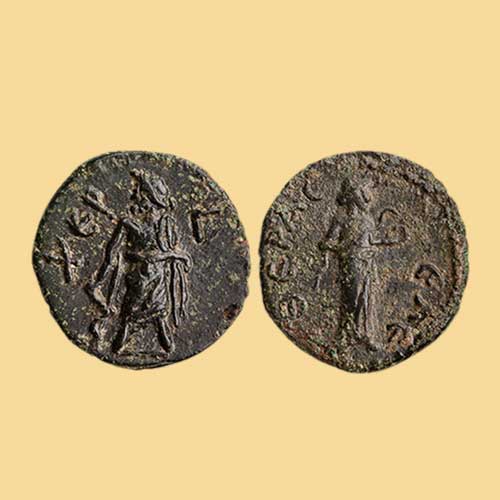
In ancient Greek art, Hygieia is often shown wearing a flowing robe and holding a #snake, which she feeds from a bowl. The Bowl of Hygeia, marked by a serpent wrapped around it, is the universal #Symbol of pharmacy. Images of Hygieia began appearing on coins in the 4th century BCE. The coin featured in this discussion is a #Bronze Coin from Chersonesos in Tauric, dating from 300 BCE to 200 BCE. This ancient Greek #city is now in present-day #Ukraine. Weighing 5.95 grams, the obverse of the coin displays Asklepios alongside the Greek letters ‘G khER.’ The reverse showcases Hygieia standing, holding a snake in her right hand and a bowl in her left, accompanied by the Greek #inscription ‘ELEUThERAS’.
Latest News
-
Extremely Rare Silver Quarter Tanka of Kachar Monarch Yasho Narayan, Owing Allegiance to Ghatotkacha Lineage
2026-06-23 TueHidden within the misty valleys and forested hills of Northeast India lies the story of the Kacha...
-
Gun and Sword on Silver Katra Taka of Independent Kingdom of Jaintiapur King Bar Gossain II
2026-06-22 MonThe Jaintia was a prominent medieval Independent Kingdom in Northeast India, ruled ...
-
Rare and Beautiful Gold Dinar of Gauda Ruler Shashanka
2026-06-19 FriThe Gauda dynasty was an ancient kingdom in the Gauda region of Bengal. It emerged as an independ...
-
Exceptional Gold Mohur of Ahom King Swargdeo Rajeshwar Singha
2026-06-19 FriThe Ahoms were ethnic group originating from the Tai people and founder of Assamese royal dynasty...
-
Heavy Lead Coin of Hiranyakas, King Khadakama
2026-06-18 ThuThe Hiranyakas were a local dynasty that rose in the mid-3rd century CE, in Rayalaseema region th...